AI Integration: Beyond the Hype

If you are a CTO or VP of Engineering and the phrase "AI transformation" makes your eyes glaze over, you are not alone. The last two years have delivered a relentless parade of AI-powered everything — chatbots with no guardrails, predictive models that never left the sandbox, boardroom presentations promising revolution and delivering PowerPoint. AI integration for business has become one of the most oversold and under-delivered promises in modern technology. But behind the hype cycle, there is a quieter, more consequential story: teams inside AEGONTECH LLC and across the industry are shipping AI features that actually move metrics — cutting ticket resolution times by 40%, automating document workflows that used to consume entire workdays, and surfacing operational insights that human analysts routinely missed.
The difference is not better AI. It is better integration.
Key Takeaways
- Most AI projects fail not because the model underperforms, but because the integration — data pipelines, orchestration, monitoring, and fallback handling — was treated as an afterthought.
- The three highest-ROI AI integration patterns today are conversational support with intelligent routing, document and data automation, and predictive analytics — not standalone chatbots.
- A disciplined AI integration strategy starts with the business problem and selects the model class last, not first.
- Fine-tuned small models often outperform large general-purpose APIs at a fraction of the per-request cost when deployed inside a purpose-built, well-instrumented system.
- Companies that instrument outcomes from day one and iterate based on eval pass rates achieve 3-5x higher AI ROI for business than those that treat AI as a one-off launch.
Why Do Most Enterprise AI Projects Fail to Deliver ROI?
They fail because the organisation bought the model before it understood the problem. Gartner estimates that through 2025 at least 30% of generative AI projects will be abandoned after proof of concept — not because the technology does not work, but because the teams building them never anchored the work to a measurable business outcome. The enthusiasm is genuine: McKinsey reports that 55% of organisations now use AI in at least one business function. But scaling from a slick demonstration to a reliable production system demands data engineering, instrumented evaluation, and an architecture that handles failure gracefully — work that is unglamorous, expensive, and utterly essential.
The gap between a Jupyter notebook and a production AI feature is where most enterprise AI implementation efforts break down. A model that scores 92% accuracy in a controlled evaluation routinely drops to the low sixties in production — not because the model changed, but because real-world data is messier, edge cases multiply without warning, and latency budgets shrink to milliseconds. If your team cannot answer the question "what happens when the model is wrong?" you do not have an AI integration. You have a science experiment with a production URL.
What Is AI Integration for Business, Really?
AI integration is the discipline of embedding artificial intelligence models — whether large language models (LLMs), which are neural networks trained on vast text corpora to predict and generate language, or traditional machine learning classifiers — into existing business systems so they produce reliable, measurable value at scale. It encompasses data engineering, API orchestration, prompt design, evaluation pipelines, monitoring, model selection, and fallback logic. In plain terms: it is everything that transforms a promising model into a dependable feature a customer can actually use.
This is distinct from AI research, where the goal is advancing model capability. It is also distinct from AI demoware, where a flashy prototype is built to impress a stakeholder and then quietly shelved. AI integration for business answers a single operational question: does this system produce correct, cost-effective outcomes at scale, in production, under real-world conditions?
Which AI Use Cases Actually Deliver Measurable Value?
After two years of shipping AI features across client projects at AEGONTECH LLC, three patterns consistently demonstrate measurable ROI while the rest remain speculative.
Conversational support and intelligent routing. This is not the frustrating chatbot that loops through pre-written scripts until the user gives up. Modern AI-powered support uses LLMs to understand intent, route complex queries to the right human agent, and auto-generate response drafts from knowledge-base articles. A well-integrated system reduces tier-one ticket volume by 30-40% and frees human agents to focus on high-value work. The critical design choice is fallback logic: when the AI is uncertain, it hands off immediately rather than generating plausible-sounding fiction.
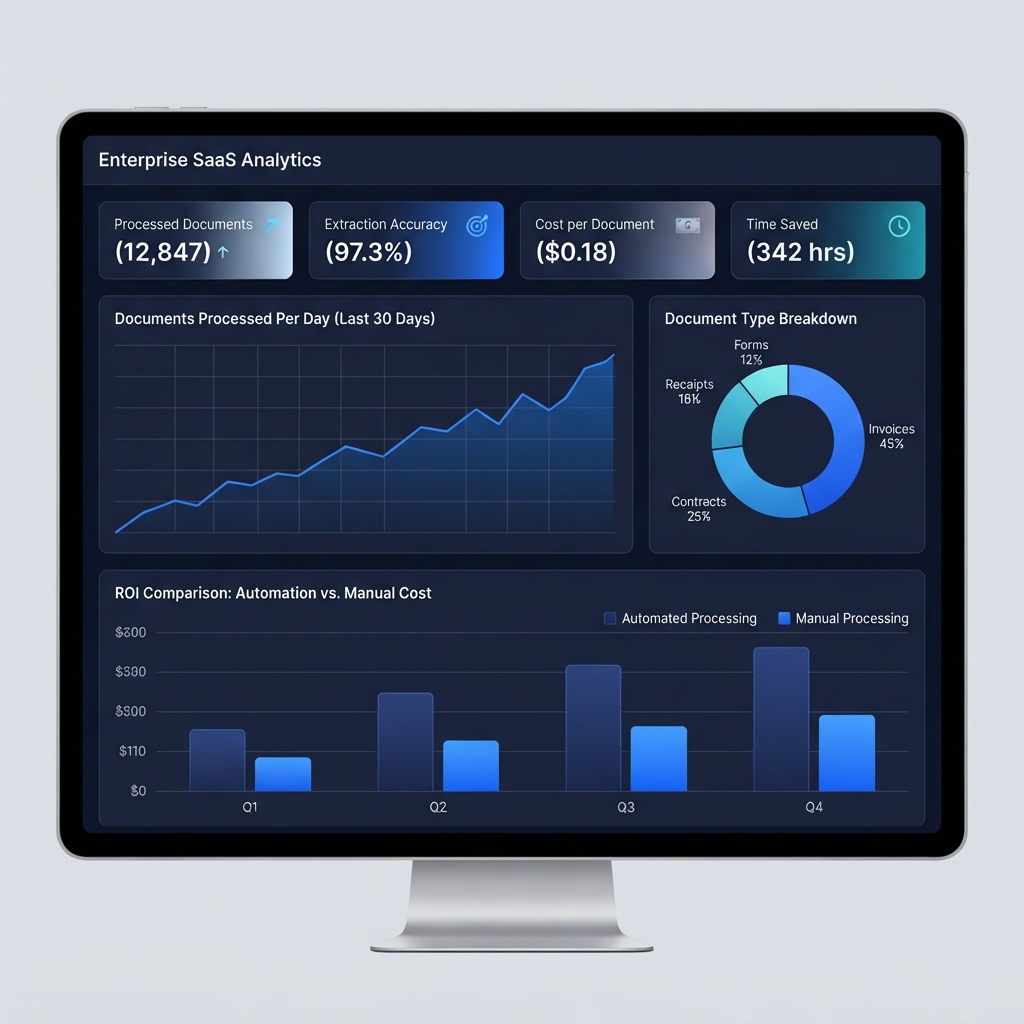
Document and data automation. Classifying incoming documents, extracting structured fields from invoices, parsing contracts for renewal dates and risky clauses — these are high-volume, rule-heavy workflows that are expensive to staff and error-prone when handled manually. Generative AI — AI that creates new content such as text, images, or code rather than merely classifying existing data — combined with optical character recognition (OCR) and a structured extraction pipeline can process thousands of documents per hour with accuracy rates above 95% when evaluated against ground truth. This is the single highest-ROI practical AI use case for mid-market and enterprise organisations today.
Predictive analytics and anomaly detection. Unlike generative AI, predictive models use historical patterns to forecast outcomes — demand spikes, equipment failure, churn risk. These are mature technologies, well-understood, and inherently measurable. A manufacturing client running predictive maintenance on sensor data can reduce unplanned downtime by 25-35% within the first twelve months. The challenge here is not the model; it is the data infrastructure required to stream, clean, and serve features reliably around the clock.
The pattern worth highlighting: none of these use cases requires a 200-billion-parameter model. Each requires a well-instrumented system wrapped around a sensibly chosen model.
What Does a Pragmatic AI Integration Strategy Look Like?
A defensible AI integration strategy has five distinct steps, and "pick the model" is step four. The organisations that get this backwards — starting with the model and hunting for a problem — almost always land on the wrong side of Gartner's 30% abandonment statistic.
Step one: define the measurable outcome. "Improve customer experience" is not measurable. "Reduce average ticket resolution time from 14 hours to 4 hours" is measurable. Before any line of code is written, the team agrees on the metric, the baseline, and the threshold that makes the project worth shipping.
Step two: assess data readiness. Every AI model consumes data, and every model outputs garbage when fed garbage. Embeddings — numerical vector representations of text, images, or other data that allow models to understand semantic similarity — need clean, representative inputs. RAG pipelines — Retrieval-Augmented Generation, a technique where the model retrieves relevant documents before generating its response rather than relying solely on its training data — require a well-structured knowledge base. If the data is siloed, inconsistent, or unlabeled, fix that first.
Step three: design for failure from day one. The model output pipeline requires guardrails: output validation, confidence thresholds, and human-in-the-loop fallback. Eval — short for evaluation, the systematic process of measuring model output quality against a curated ground-truth dataset — is not a post-launch nicety. It is the difference between knowing whether your system is improving and discovering it has been silently degrading for three months.
Step four: select the model class, not the brand. For most business tasks, a fine-tuned 7B-parameter model — fine-tuning being the process of further training a pre-trained model on a specific, smaller dataset to adapt its behaviour to a domain — deployed on dedicated infrastructure will outperform a general-purpose API call at a fraction of the per-token cost. Predibase has demonstrated that fine-tuning a small open-source model for a domain-specific task can cost as little as $8 versus $3,000 or more per month in enterprise API costs at meaningful scale. The model should fit the problem, not the press release.
Step five: instrument and iterate. Ship a minimum viable AI feature. Measure everything: latency, accuracy, cost per request, user acceptance rate. Improve based on data, not intuition. BCG research shows that companies treating AI as an iterative product rather than a one-off project achieve 3-5x higher AI ROI for business — the compounding advantage of a learning system over a static deployment.
How Much Does AI Integration for Business Actually Cost?
AI implementation cost varies dramatically based on integration depth and throughput requirements, but a realistic budget for a production-grade AI feature ranges from $50,000 to $250,000 for the first use case, with ongoing operational costs of $3,000 to $15,000 per month depending on model selection and request volume. Off-the-shelf API costs are predictable but scale poorly at enterprise throughput. Self-hosted fine-tuned models require upfront infrastructure investment but deliver dramatically lower per-request costs at volume — often 60-80% cheaper at scale than pay-per-token enterprise APIs.
The hidden cost most teams underestimate is not compute. It is maintenance. Models drift as data distributions shift over time. Prompt templates need updating as API providers change their interfaces. Evaluation datasets require ongoing curation. Expect to budget 20-30% of the initial build cost annually for ongoing model operations — the discipline known as MLOps, or machine learning operations, which applies DevOps principles to the full lifecycle of AI models from training through deployment and continuous monitoring.
How Do You Choose the Right AI Model for Your Business Problem?
Start by asking what the system needs to produce, not what the model can generate. A classification task — "is this invoice compliant?" — needs a classifier, not a general-purpose LLM. A summarisation task — "produce a 150-word executive summary of this 20-page report" — benefits from an LLM with strong instruction-following capabilities. A multi-step reasoning workflow — "analyse this contract, flag risky clauses, and draft counter-language" — may warrant an AI agent: a system that uses an LLM as a reasoning engine, augmented with tools, memory, and the ability to plan and execute multi-step workflows autonomously.
At AEGONTECH LLC, the team applies a straightforward decision framework: classify the output type (structured, unstructured, multi-step), define the latency budget (synchronous user-facing, asynchronous background, or batch processing), assess the accuracy tolerance (zero-tolerance vs acceptable error rate), and then — only then — evaluate model options from providers including OpenAI, Anthropic, and open-source models served via AWS or self-hosted infrastructure with Docker and Kubernetes. Products like Dolfy.ai, AEGONTECH's AI-powered mobile app designer, and Mimicall, a persona-driven voice agent platform, demonstrate this pattern in practice: the AI capability is visible to the user, but the engineering underneath ensures reliable, monitored, cost-controlled operation — not a raw model endpoint behind a login screen.
FAQ
What is the difference between generative AI and traditional machine learning? Traditional machine learning classifies or predicts based on patterns in structured data — think fraud detection, demand forecasting, churn prediction. Generative AI creates entirely new content — text, images, code — typically using large language models or diffusion models. Most practical business systems use both: traditional ML for structured decisions, generative AI for unstructured content generation and complex reasoning.
How long does an enterprise AI integration typically take from concept to production? A focused single-use-case integration — document automation, intelligent routing, or a RAG-powered knowledge assistant — can ship in 8 to 14 weeks with an experienced team. More complex multi-agent or multi-model systems take 3 to 6 months. The timeline is driven less by model complexity than by data readiness and integration surface area.
Should our team build AI in-house or use third-party APIs and services? For early experimentation, third-party APIs from providers like OpenAI or Anthropic give the fastest path to a working prototype. For production at scale — high throughput, low latency requirements, or sensitive data — a fine-tuned self-hosted model typically delivers better performance, lower cost per request, and stronger data governance. Most enterprises land on a hybrid model: APIs for exploration, custom deployments for production workloads.
What level of AI expertise does our team need to integrate AI responsibly? One experienced ML engineer or AI integration specialist who understands evaluation, prompt engineering, and production deployment is sufficient for most single-use-case integrations. The broader team needs enough literacy to collaborate effectively — defining requirements, curating evaluation datasets, and interpreting model outputs — but does not require deep ML research expertise. The bottleneck is almost always engineering discipline, not AI research depth.
Where AI Integration Goes From Here
The organisations that will extract meaningful value from AI over the next three years are not the ones chasing the latest model release. They are the ones treating AI integration as a core engineering discipline: start with the business outcome, match the model to the problem, instrument everything, and iterate relentlessly. The performance gap between organisations that do this and those that do not will widen faster than any technology cycle we have witnessed — not because the AI itself is getting exponentially better, but because the compounding advantage of reliable, measured, continuously improving AI systems dwarfs the one-off demo every time.
Whether you are evaluating your first AI integration for business, scaling from pilot to production, or rebuilding a system that was launched too fast to be sound, the principles remain the same and the clock is running. AI is becoming infrastructure. The question is whether your organisation builds it well or patches it later. If you are ready to move past the demos and ship AI features that your customers can actually depend on, the engineering team at AEGONTECH LLC builds AI-integrated software on the same stack — React, Next.js, Node.js, Python, AWS, Docker, and Kubernetes — with evaluation, monitoring, and fallback logic built in from sprint one.